
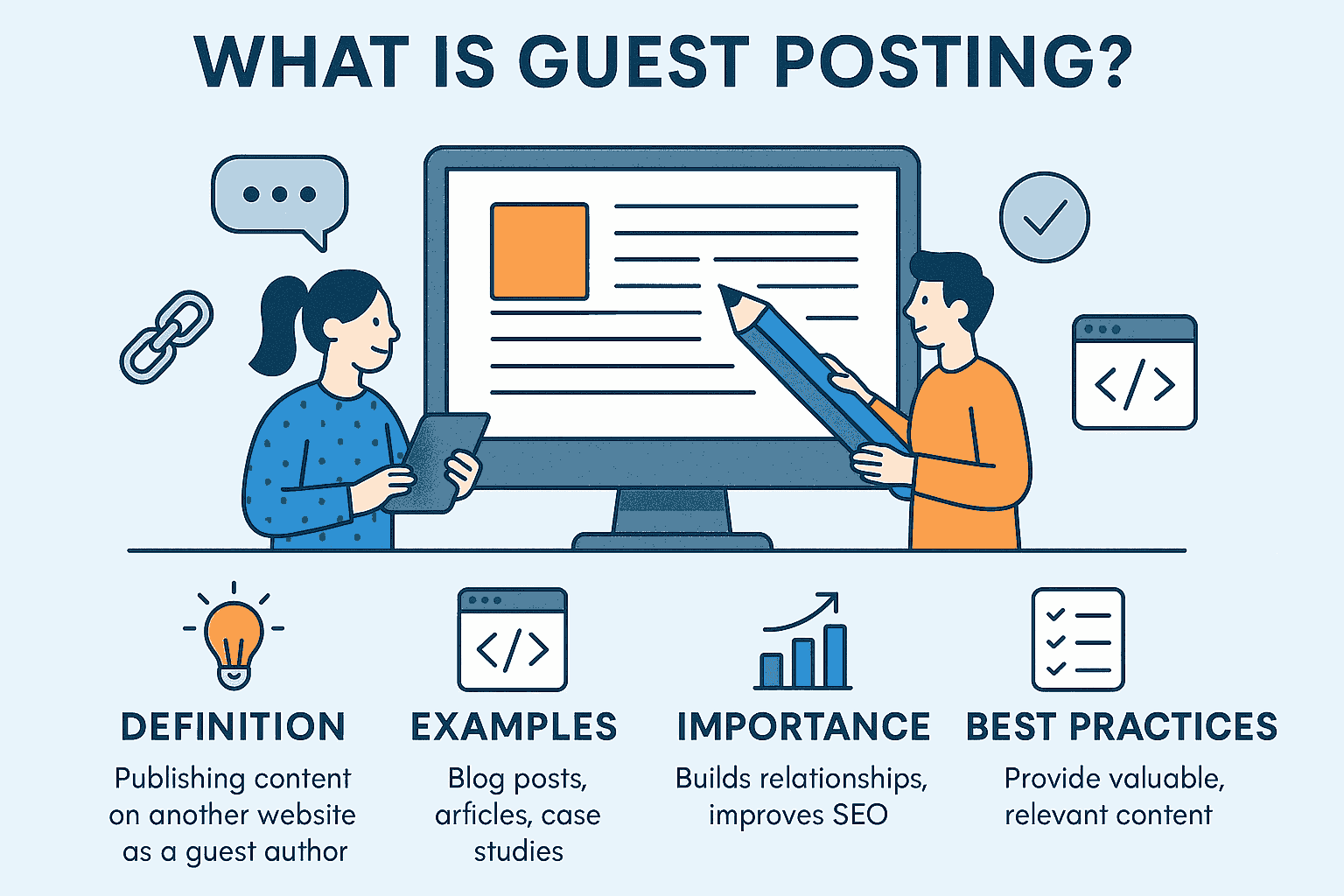
In 2025, guest posting continues to be one of the most effective strategies for building online visibility. At its core, guest posting means writing an article for someone else’s website or blog—usually within your industry. It’s a simple exchange: you contribute valuable content, and in return, you get exposure to a new audience, a link back to your own site, and a stronger presence in your niche.
But don’t confuse guest posting with outdated link-spamming tactics. In today’s digital landscape, quality matters more than ever. Guest posts are now seen as relationship builders, credibility boosters, and powerful tools for SEO—if done right.
Why Guest Posting Still Matters
With content marketing becoming more competitive every year, simply publishing blogs on your own site isn’t enough. Your target audience is scattered across the internet, consuming content from trusted sources they already follow. Guest posting helps you show up in those spaces.
It positions your brand in front of the right people, in the right place, at the right time. Whether you’re a small business owner, a startup founder, or a digital marketer, guest posting can:
- Introduce your brand to new, relevant audiences
- Improve your website’s authority in Google’s eyes
- Drive targeted, long-term traffic
- Build real relationships with editors and site owners
- Help you become a known voice in your industry
In short, it’s not just about links—it’s about visibility, trust, and growth.
Is Guest Posting Still Worth It in 2025?
Absolutely. Despite what some skeptics say, guest posting still works—if it’s done the right way. Google is smarter now, and it favors useful, authentic content published on quality sites. That’s exactly what modern guest posting aims for.
If you’ve been wondering, “Does guest posting still work?”, the answer is a firm yes. (We’ll break that down later in the post.)
And if you’re looking for a hands-off way to tap into guest blogging without the hassle of outreach and writing, our guest post service can help you get published on real, high-authority websites with content that truly adds value.
What Is Guest Posting?
A guest post is a blog article written by someone who doesn’t own the website it’s published on. In other words, you’re a “guest” on someone else’s platform. Instead of publishing the post on your own blog, you write it for another website—usually one that already has an established audience in your niche.
For example, if you run a fitness brand, you might write a blog post like “5 Quick Workouts for Busy Professionals” and publish it on a popular health or lifestyle blog. In return, you usually get a short bio with a link back to your website. That’s the heart of guest posting—share value, earn visibility.
A Quick Look at the History
Guest posting began as a grassroots effort among bloggers to support each other’s audiences and build online connections. In the early 2010s, it became a favorite tool among SEOs to gain backlinks. But like all good things, some marketers abused it—mass-producing low-quality posts for links alone.
As a result, Google cracked down hard. In 2014, they warned against spammy guest posts. Many thought guest blogging was “dead.” But in truth, it just evolved.
Today, guest posting is alive and well—but it’s all about quality. Sites now demand content that’s original, relevant, and helpful to their readers. It’s no longer about stuffing a link into a 400-word post—it’s about offering real value that benefits everyone involved.
And that’s exactly how we approach guest posts at our service: genuine content, published on trustworthy sites, crafted to bring long-term results.
Guest Post vs. Blog Post vs. Article: What’s the Difference?
Let’s clear up a common confusion:
| Term | Where It’s Published | Who Writes It | Purpose |
| Blog Post | On your own blog or site | You or your in-house writer | To inform, engage, or rank |
| Guest Post | On someone else’s blog | You (as a contributor) | To gain exposure and backlinks |
| Article | Anywhere (magazine, blog, etc.) | Could be anyone (freelancer, journalist) | Broader term, can include news, blogs, guest posts, etc. |
In short:
- All guest posts are articles, but not all articles are guest posts.
- Guest posts are defined by where they’re published and why they’re written.
Guest Post Example
Understanding the concept of guest posting is easier when you see a real-world example. Let’s break it down step by step so you know exactly what a guest post looks like—and how it’s structured.
Live Example Breakdown
Imagine you’re a digital marketer who helps small businesses grow through SEO. You pitch a topic to a popular marketing blog like “The 5 Most Common SEO Mistakes Small Business Owners Make.”
Here’s how the published guest post might appear:
📰 Title:
“5 How SEO can Boos Your Sales (And How to Fix Them)”
✍️ Byline:
By John Smith, Guest Contributor
📄 Body Content (Excerpt):
Search engine optimization (SEO) is powerful—but only when done right. Unfortunately, many small business owners still make beginner mistakes that cost them rankings and traffic. In this post, we’ll explore five of the most common ones, and how to avoid them…
🔗 Backlink Example:
…For a deeper dive, check out this free SEO checklist you can use to audit your site.
👤 Author Bio at the End:
John Smith is an SEO strategist and founder of Linklume. He helps small businesses improve their online visibility through customized SEO plans. Learn more at linklume.com.
As you can see, guest posts feel just like any helpful blog article—but the difference lies in who writes it and where it’s published.
What It Looks Like Visually
Most guest posts look just like any regular blog article on the host site. There’s:
- A featured image
- Headings and subheadings
- Internal links to the host’s content
- One or two relevant external links (like your website or a lead magnet)
- A clear author bio or contributor box
Some blogs include a profile photo and even social media links—making it easy for readers to trust and connect with the writer.
Anatomy of a Guest Post: Structure Breakdown
Here’s a simple structure almost all successful guest posts follow:
- Headline – Eye-catching, clear, and relevant to the audience.
- Introduction – Hook the reader, introduce the topic, and set expectations.
- Body – Deliver value. Use tips, examples, bullet points, images—whatever helps educate or solve a problem.
- Call-to-Action (CTA) – Ask the reader to comment, try something, or think differently.
- Author Bio – A short paragraph about who you are, what you do, and a link to your website, landing page, or product.
👉 If writing this sounds like a lot, don’t worry. At Linklume, we handle all of it—from research and writing to outreach and publishing—so you don’t have to lift a finger. You focus on growing your business; we’ll take care of getting you featured.
What Is the Purpose of Guest Posting?
Guest posting may sound like a simple idea—write an article and publish it on someone else’s blog—but the benefits go far beyond just having your name appear on another site. When done with the right intent and strategy, guest posting becomes a smart marketing move with multiple layers of value.
Here’s why guest posting matters—and why so many businesses still invest in it in 2025.
1. Build Backlinks (The Right Way)
Backlinks are links from other websites that point to your own. Google sees these as “votes of confidence,” and they’re one of the strongest signals search engines use to rank pages.
When you publish a guest post on a quality website and include a link back to your site (usually in your author bio or within the content), you gain a backlink that can boost your SEO.
But it’s not just about quantity. One link from a trusted, relevant site can often outweigh ten from low-quality ones.
That’s why at Linklume, we don’t chase spammy links. We focus on placing high-quality guest posts on real sites that actually move the needle for SEO.
2. Increase Brand Awareness
Guest posting allows you to step into someone else’s audience—an audience that likely doesn’t know your brand yet.
By writing for blogs in your industry, you introduce your business, your voice, and your solutions to people already interested in what you offer. Even if they don’t click right away, your name sticks. Over time, this builds recognition and trust.
Think of it as digital word-of-mouth—only at scale.
3. Drive Referral Traffic
Every guest post is a chance to bring new visitors to your site. If your article is helpful and your bio or CTA is compelling, people will want to learn more about you.
This type of traffic is called “referral traffic” because it comes from another site referring their readers to yours. And it’s often highly qualified—these visitors already trust the site you wrote for, and now they’re interested in you.
It’s not uncommon for a single well-placed guest post to bring in hundreds (or even thousands) of visitors over time.
4. Establish Thought Leadership & Credibility
Publishing on respected websites tells the world, “I know what I’m talking about.” It helps you build authority in your niche and positions you as someone worth listening to.
This is especially powerful for:
- Consultants
- Coaches
- Agencies
- SaaS founders
- Service-based business owners
When people see your content on trusted sites, they begin to associate your name with value and expertise—which makes them more likely to follow you, subscribe, or buy from you later on.
Whether your goal is SEO, traffic, or reputation, guest posting ties all three together. And if you want to skip the cold emails, content writing, and rejection, our team can handle the entire process for you. We help you get published where it counts, so you can reap all the benefits without the legwork.
Is Guest Posting Real or Fake?
If you’ve spent any time researching SEO or content marketing, you’ve probably heard mixed opinions about guest posting. Some people swear by it. Others say it’s outdated or even “fake.” So, what’s the truth?
Let’s break down the misconceptions and look at what guest posting really is in 2025.
Misconceptions vs. Reality
Misconception #1:
“Guest posting is just a scam to get backlinks.”
✅ Reality: When done poorly, yes—some people have tried to game the system with low-quality, spammy posts. But when done with value and relevance in mind, guest posting is a respected, long-standing marketing strategy. Quality sites don’t publish junk—and readers won’t stick around if they do.
Misconception #2:
“Google banned guest posting.”
✅ Reality: Google never banned guest posting. What they’ve warned against is manipulative guest posting—where the only goal is to stuff in a link. Google is fine with genuine content written to help readers, not fool algorithms.
Misconception #3:
“It doesn’t work anymore.”
✅ Reality: Guest posting still works extremely well—when the focus is on helping, not just ranking. Reputable blogs still publish guest contributors. Smart marketers still use guest posts to gain exposure and traffic.
White-Hat vs. Black-Hat Guest Posting
In SEO terms:
- White-hat guest posting means writing high-quality, relevant content for real websites that care about their audience. This is ethical and supported by Google.
- Black-hat guest posting involves paying shady sites to publish low-effort content filled with keyword-stuffed links—just to try and manipulate rankings.
Black-hat tactics might work temporarily, but they’re risky and can get your site penalized. On the other hand, white-hat guest posting builds long-term credibility, real authority, and search trust.
At Linklume, we only offer white-hat guest post services. That means every placement we secure for clients is on a legitimate, quality blog with real traffic and editorial standards.
What Does Google Say About Guest Posting?
Google has spoken about guest posting many times over the years. Their main stance is clear:
“Guest blogging is fine, but what you’re doing matters more than what you’re calling it.”
In short, Google is not against guest posting itself. They’re against abuse of it.
Here’s what Google actually wants:
- High-quality, unique content
- Relevance between the writer and the blog’s topic
- Editorial standards (not just ‘pay to publish’ setups)
As long as your guest post offers value to real readers and isn’t just a vehicle for links, you’re on the right side of Google’s guidelines.
So, is guest posting real?
Yes—when it’s done ethically, thoughtfully, and with real humans (not bots or shortcuts) in mind.
And if you’re serious about growing your brand the right way, we can help you land on high-quality blogs that meet both reader expectations and Google’s standards.
Are Guest Posts Paid or Free?
One of the most common questions people have about guest posting is: Do I have to pay to publish my post on someone else’s blog? The answer isn’t black and white. In reality, guest posts can be either free or paid—it depends on the site, the niche, and the value exchange involved.
Let’s break it down.
Free Guest Posts
Traditionally, guest posting began as a free, mutual exchange. You write a valuable article for a blog owner. In return, you get:
- A backlink to your site
- Exposure to their audience
- A short author bio
This type of arrangement still exists, especially if:
- The blog isn’t highly commercial
- You already have a relationship with the site owner
- Your content is extremely high-quality and relevant
- The blog is actively looking for contributors
But here’s the truth in 2025: many of the top sites now charge to accept guest posts.
Paid Guest Posts
More and more blogs—especially those with large audiences, high domain authority, or niche-specific traffic—charge a publishing or review fee. Why?
Because maintaining a blog costs time and money. Reviewing content, formatting it, editing, and promoting it are all part of running a site. Paid guest posts are simply a way to support that.
In a paid guest post setup:
- You (or your agency) still write the article.
- The host site charges a one-time fee to publish it.
- You typically get to include 1 or 2 links, a custom bio, and sometimes images or brand mentions.
Some sites even offer premium placements—like homepage features, email newsletters, or sponsored social shares—at an added cost.
What Factors Influence the Cost?
Several factors determine whether a guest post will be free, paid, or somewhere in between:
| Factor | How It Affects Price |
| Domain Authority (DA) | The higher the DA, the more valuable the backlink—and the higher the cost. |
| Monthly Traffic | Sites with more readers often charge more for exposure. |
| Industry/Niche | Competitive niches like finance, CBD, tech, and gambling usually have higher rates. |
| Editorial Quality | Professional blogs with strict content guidelines may charge for their time. |
| Placement Type | Homepage feature, category page, or just buried in the blog section—all priced differently. |
So… How Much Does a Guest Post Cost?
Here’s a general pricing range based on industry trends in 2025:
- Free to $50 → Small blogs or personal websites
- $100–$300 → Mid-tier niche blogs with decent traffic
- $300–$800+ → High-authority sites with strong SEO metrics
- $1,000+ → Premium publications or business media sites
💡 Looking for a cost-effective start? At Linklume, our guest post services begin at just $4—making high-quality backlinks and exposure accessible to every budget.
It’s important to remember that you’re not just paying for a blog post—you’re investing in visibility, SEO, and long-term value.
At Linklume, we work with a wide range of publishers—from niche blogs to big authority sites—and match you with placements that fit your goals and budget. Whether you’re starting small or aiming big, we handle the entire guest post process—from outreach to content to live link.
Who Needs Guest Posting?
Guest posting isn’t just for bloggers anymore. In 2025, it’s a powerful tool used by a wide range of professionals and businesses to grow online visibility, earn credibility, and connect with new audiences.
If you’re wondering whether guest posting is right for you, here are the four types of people who benefit the most—and why they keep coming back to it.
Freelancers: Build Authority & Attract Clients
Freelancers—especially those in writing, design, coaching, and digital services—often rely on personal branding to attract clients. One of the best ways to build that brand is to share your expertise on platforms your audience already trusts.
Let’s say you’re a freelance copywriter. If you publish a smart article on “5 Copywriting Mistakes Startups Make” on a popular marketing blog, you instantly earn trust from readers who may need your services.
Guest posting helps freelancers:
- Establish credibility
- Create content that can be referenced in pitches
- Get inbound client inquiries
- Build a personal SEO footprint
Pro tip: Even one strong guest post on a niche blog can lead to long-term client leads—especially when paired with a great author bio and call-to-action.
Startups & Small Businesses: Get Found Without Ads
When you’re running a startup or small business, marketing budgets are tight. You can’t afford to burn money on paid ads forever. That’s where guest posting comes in—it’s an affordable, long-term strategy to:
- Drive traffic to your product or service
- Build backlinks to your site (improving search rankings)
- Introduce your brand to new audiences
- Compete with larger players without spending like them
And let’s be honest—getting featured on respected blogs makes your brand look more professional, even if you’re just starting out.
At Linklume, we help startups land placements that not only generate buzz but also support SEO growth in a sustainable way.
SEO Agencies: Scale Link Building the Smart Way
SEO agencies often need to deliver high-quality backlinks to multiple clients. But guest posting at scale takes time, effort, and a strong network of real publishers.
That’s why many SEO professionals turn to guest posting services. It’s the safest and most effective way to earn natural backlinks, especially after Google’s stricter stance on link manipulation.
Agencies benefit from:
- Outsourcing outreach and content
- White-label delivery
- Scalable link-building campaigns
- Placements that pass manual inspections
If you’re an agency, we can act as your behind-the-scenes content and outreach partner—so your team stays focused on strategy, while we handle execution.
Influencers & Thought Leaders: Be Seen as an Expert
If you’re trying to grow your personal brand or build a reputation in your industry, nothing boosts your credibility like being featured on the blogs people already follow.
Whether you’re in finance, health, marketing, or tech, publishing thoughtful guest posts helps you:
- Position yourself as a thought leader
- Attract podcast invites, speaking gigs, or partnerships
- Build a digital footprint beyond social media
- Earn organic followers who value your insights
A single well-written guest post can open doors that take months to unlock through cold outreach alone.
No matter who you are—freelancer, founder, marketer, or coach—guest posting helps you get noticed by the right people in the right places.
And if you’re not sure where to start, we’re here to help. From finding the right blogs to writing and publishing your content, our guest post service is built to take the pressure off and deliver results you can measure.
Is Guest Posting Worth It in 2025?
It’s a fair question—especially with so many marketing tactics available today. From social media ads to influencer shoutouts to YouTube content, it’s easy to overlook the power of a good old blog post.
But here’s the truth: guest posting is still 100% worth it in 2025—when done with strategy and quality in mind.
Let’s explore why it still works, how it performs in today’s SEO landscape, and what kind of returns you can expect.
Current SEO Trends Support Guest Posting
Google’s algorithm has evolved, but the core principle remains the same: provide value, earn trust, and build natural authority.
Guest posting fits neatly into this model—especially when the content:
- Is well-written and helpful
- Is published on relevant, trusted websites
- Earns natural engagement from real readers
- Avoids spammy or manipulative link-building tactics
With AI-generated content flooding the internet, Google is leaning more than ever toward authentic, experience-based content from real people. Guest posts that demonstrate real-world knowledge are exactly the kind of content Google wants to reward.
That’s why guest posting isn’t outdated—it’s aligned with where SEO is heading.
ROI Metrics: What Do You Actually Get Back?
Let’s talk results. Guest posting may not offer instant gratification like running an ad, but its ROI builds steadily over time.
Here’s what you’re really getting:
| Benefit | ROI Value |
| Backlinks | Improve domain authority and help your pages rank |
| Referral Traffic | Real people clicking from your guest post to your site |
| Brand Mentions | Increase your online visibility and name recognition |
| Lead Generation | Targeted readers may convert into subscribers or customers |
| Trust Signals | Being featured on respected sites boosts credibility |
Even one solid backlink from a DA 70+ blog can improve your SEO visibility for months—or years.
And with the right topics and placements, you can generate traffic long after the post goes live. That’s what makes guest posting such a powerful long-term asset.
Long-Term Benefits vs. Short-Term Gains
Let’s compare guest posting to typical short-term marketing methods:
- Paid ads deliver fast traffic—but stop the moment you pause your budget.
- Social media posts create engagement—but disappear in a feed within hours.
- Guest posts stay live for years, continue attracting readers, and grow in SEO value over time.
Guest posting doesn’t just give you a backlink—it gives you a permanent piece of content on someone else’s real estate, working for you 24/7.
In 6–12 months, a few well-placed guest posts can lead to:
- Higher rankings on Google
- Increased organic traffic
- More people recognizing your name and brand
- Better conversions from people who already trust your voice
And the best part? You don’t need hundreds of posts. Just a handful of strategic placements can completely shift your online growth trajectory.
That’s exactly what we focus on at Linklume—intentional guest posting that gives you long-term results, not just short-term metrics.
Guest posting in 2025 isn’t just “still worth it”—it’s a smarter investment than ever. You’re not chasing algorithms. You’re building real authority, one post at a time.
Here’s section 9, structured as a human-friendly, step-by-step explanation. It keeps the tone helpful, avoids jargon, and naturally sets up your service as a solution for readers who want support:
How Does Guest Posting Work?
Guest posting might sound complex, but when you break it down, it’s actually a straightforward process. It’s about building real connections, offering value, and showing up where your audience is already spending time.
Here’s how guest posting works—step by step.
Step 1: Finding the Right Opportunities
The first step is identifying blogs or websites in your niche that accept guest contributions. You want to target sites that:
- Share similar topics to your business
- Have an active, engaged audience
- Are respected and indexed well by Google
- Offer clear contributor guidelines
You can find these opportunities by:
- Using Google searches like “write for us” + your keyword
- Looking at where your competitors are getting backlinks
- Checking social media (Twitter and LinkedIn often have open calls for contributors)
- Using SEO tools like Ahrefs or Ubersuggest
This part takes time—but it’s worth it. A single post on the right site can drive more results than ten on the wrong ones.
Short on time? Our guest post service has a pre-vetted list of active, real sites ready to publish content—so you don’t have to do all the searching yourself.
Step 2: Pitching the Idea
Once you’ve found a few potential blogs, the next step is to pitch your article idea. This is where many people get stuck.
Your pitch should be:
- Short and friendly
- Personalized (mention a post you liked or reference their audience)
- Clear on value (what your post will help their readers learn or solve)
Here’s a simple example:
“Hi [Name], I really enjoy your content on [topic], especially your recent article on [post title]. I’d love to contribute a guest post to your blog. Would you be open to an article on [insert 1–2 topic ideas] that’s practical, easy to follow, and tailored to your readers?”
Editors get tons of pitches, so keep it respectful and to the point.
Step 3: Writing and Submitting the Post
Once your topic is approved, it’s time to write the article.
Here’s what most editors expect:
- Original content (not published elsewhere)
- A word count of 800–1,500 words
- Proper formatting (H2s, bullet points, short paragraphs)
- Relevant examples, data, or tips
- A short author bio with a link to your site
Always check the blog’s guidelines before submitting. Some may ask for a Google Doc, others want a WordPress draft. Following their instructions shows you’re professional—and increases the chance of getting published.
Don’t forget to include 1–2 contextual links to your own site, placed naturally within the content or in the author bio.
And if writing’s not your strong suit, we’ve got you covered—our team crafts custom guest posts that meet editorial standards and speak to your audience.
Step 4: Tracking Performance
Once the guest post goes live, the real work begins: measuring the results.
Here’s how to track how your guest post is performing:
- Google Analytics: Monitor referral traffic from the site you posted on
- UTM Links: Use tracking links to measure clicks or conversions
- Backlink Checkers: Tools like Ahrefs or Moz can show your new backlinks
- Engagement Metrics: Look at social shares, comments, and reaction
You won’t always see instant results, but good guest posts continue to bring value for months (sometimes years) after they’re published.
Summary
To recap, here’s what guest posting looks like in action:
- Find quality blogs in your niche
- Pitch a topic the audience will care about
- Write a helpful, well-structured article
- Track your traffic, engagement, and rankings
And if you’d rather skip all the outreach, writing, and back-and-forth emails, our guest post service is here to help. We’ll manage everything and get you published on real, relevant blogs—without the stress.
Here’s section 10, written in a clear, practical, and beginner-friendly way that walks readers through proven methods to find quality guest post opportunities:
How to Find Guest Post Opportunities
Finding the right blogs to contribute to is often the trickiest part of guest posting—but it doesn’t have to be. Once you know where to look and what to search for, you can uncover dozens (even hundreds) of potential sites that accept guest content in your niche.
Here are four of the most effective ways to discover guest posting opportunities in 2025.
1. Use Google Search Operators
This is one of the easiest and most reliable methods. You simply type special phrases into Google to uncover websites that actively accept guest contributions.
Here are some proven search strings to try:
- “your topic” + “write for us”
- “your topic” + “guest post guidelines”
- “your topic” + “submit a guest post”
- “your topic” + “guest author”
- “your topic” + “contribute”
For example:
If you’re in the finance niche, search:
finance “write for us”
You’ll likely find a mix of blogs, news sites, and niche publications that are open to submissions. Just make sure the blog is active, has decent traffic, and fits your audience.
2. Analyze Competitor Backlinks
If your competitors are using guest posting (and many are), you can reverse-engineer their strategy.
Here’s how:
- Use a tool like Ahrefs, Ubersuggest, or SEMrush
- Enter your competitor’s domain
- Filter their backlinks by “guest post” or look for links coming from blogs or content pages
Look at where they’re getting featured. If a site published their guest post, it may accept yours too—especially if you bring something fresh or unique.
This method saves a lot of time and gives you a list of pre-qualified targets.
3. Search on Twitter & LinkedIn
Many bloggers and editors promote new guest posts or put out calls for contributors on social media—especially Twitter and LinkedIn.
Try searching:
- guest post
- guest contributor
- submit a guest post
- looking for guest writers
On Twitter, use quotes and hashtags. For example:
#guestpost or “guest post by” + your niche
On LinkedIn, look for content creators or editors in your industry. If you see someone consistently publishing content, reach out and ask if they accept guest submissions.
4. Use SEO & Content Tools
If you want to dig even deeper (and faster), several SEO tools can help streamline your guest post research.
Here are a few to consider:
- Ahrefs (Content Explorer): Search for keywords and filter by “guest author” or “guest post by” to find guest-written articles across the web.
- Ubersuggest: Enter a competitor’s domain and explore their backlinks and top-performing content.
- BuzzSumo: Find top-shared content in your niche and check if those sites accept contributions.
- Hunter.io: Once you find a site, use Hunter to look up editor or contributor contact emails.
These tools may come with a learning curve, but they’re gold mines for finding blogs with high domain authority and engaged audiences.
Bonus: Tap Into Guest Post Networks
Some platforms and communities exist specifically for guest bloggers and publishers, such as:
- MyBlogGuest (if still active in your region)
- GuestPost.com
- WriteForUs.io
- Blogger networks in Facebook or Slack groups
If you don’t have the time or tools to do all this research manually, that’s exactly what our service at Linklume is designed for. We maintain an updated network of trusted blogs across multiple industries and can connect you with sites that match your goals—fast.
Here’s section 11, structured to guide readers clearly while keeping the tone supportive and approachable. It offers practical writing advice and builds trust in your service’s quality:
How to Write a Great Guest Post
You’ve found the right blog, pitched your idea, and now it’s time for the most important part: writing a guest post that actually gets published—and performs well.
Whether you’re writing it yourself or hiring a service (like ours), here’s how to craft a guest post that editors and readers will both love.
Format and Tone: Match the Blog’s Style
Before you write a single word, study the blog you’re submitting to. Read a few of their latest posts and take note of:
- Tone: Are they casual and fun, or professional and data-driven?
- Audience: Are they writing for beginners or industry experts?
- Structure: Do they use short paragraphs, subheadings, images, or bulleted lists?
Your post should feel like a natural fit for their site. If their audience loves how-to guides with screenshots, don’t send in a fluffy opinion piece. If their tone is conversational, skip the jargon.
📌 Pro Tip: Use subheadings every few paragraphs. It makes the content easier to scan—and easier to publish.
SEO Optimization: Write for People First, Then Google
Guest posts still help with SEO—but not if they’re written like they were made for a robot.
Here’s how to strike the right balance:
- Focus on one primary keyword, but use it naturally in the title, intro, and a few times in the body.
- Add related terms and variations that people might search for.
- Use headers (H2s, H3s) to break up your content and include keywords when it makes sense.
- Write meta-level content—something that’s helpful enough to earn clicks and links on its own.
Don’t over-optimize. The goal is to write something so good that readers (and Google) can’t ignore it.
Internal and External Links: Be Helpful, Not Salesy
Editors expect you to include a mix of:
- Internal links to relevant content already published on their blog
- External links to credible sources, stats, or studies
- One link to your own site (often in the bio, or occasionally in the body if it’s contextual)
What you don’t want to do is stuff in five links to your product or homepage. That’s a fast way to get rejected.
Use links to add value—not just promote yourself. A good rule of thumb? If the link helps the reader, keep it. If it only helps you, remove it.
Guest Post Dos and Don’ts
DO:
- Research the blog before you write
- Stick to one clear topic
- Make it skimmable with headers and bullet points
- Include original insights or experiences
- Add a simple CTA or question at the end to encourage engagement
DON’T:
- Copy or rewrite old blog posts
- Over-promote your product or service
- Submit thin content (less than 800 words)
- Use stocky, generic intros (“In today’s fast-paced digital world…”)
- Forget to proofread
A well-written guest post does more than check SEO boxes—it builds trust with a new audience. And if writing isn’t your thing (or you’d rather skip the editor back-and-forth), our team can craft expert-level guest posts that fit seamlessly into any blog’s content strategy.
You focus on running your business. We’ll handle the writing that gets you seen.
Here’s section 12, written in a human, encouraging tone that guides readers through the pitching process and includes a plug-and-play email template:
How to Pitch a Guest Post That Gets Accepted
Even the best blog idea won’t go anywhere if you don’t pitch it the right way. Editors get flooded with emails every week—many of them generic, irrelevant, or clearly copy-pasted.
If you want your guest post pitch to stand out and actually get accepted, you need to do two things right: research and personalization.
Let’s walk through exactly how to do that.
Step 1: Research the Blog You’re Pitching
Before you hit send, take 5–10 minutes to understand the blog:
- What kind of content do they publish?
- Who is their target audience?
- What are their most popular posts?
- Have they published guest authors before?
- Do they have a “Write for Us” or contributor page?
Look at the blog’s tone, topics, and engagement. If their latest posts are detailed guides for small business owners, don’t pitch them a generic listicle about “10 Ways to Make Money Online.”
Instead, match their content style and offer something fresh that still fits their theme.
📌 Pro Tip: Reference a specific article from their site in your pitch—it shows you’ve done your homework.
Step 2: Craft a Short, Friendly Pitch Email
Your email doesn’t have to be fancy. It just needs to be:
- Polite and to the point
- Tailored to the blog you’re pitching
- Focused on value for their readers (not just your backlink)
Avoid long intros or paragraphs about your resume. The editor just wants to know:
➡️ Who are you?
➡️ What do you want to write about?
➡️ Why is it relevant for their audience?
Real Guest Post Pitch Template (Copy & Customize)
Subject: Guest Post Idea for [Blog Name]
Hi [Editor’s Name],
I’ve been reading your blog and really enjoyed your recent article on [Post Title]. I’d love to contribute a guest post that’s tailored to your audience.
Here are a couple of topic ideas I had in mind:
- [Headline 1] – [1-sentence summary of the idea]
- [Headline 2] – [1-sentence summary of the idea]
I’ve written for sites like [Name-drop 1–2 if you can], and I’d be happy to follow any guidelines you have.
Let me know if one of these sounds like a fit—I’d love to send over a draft.
Thanks so much!
[Your Name]
[Your Website] (optional)
[LinkedIn/Twitter] (optional)
💡 Even if you don’t have published writing samples, you can link to your blog or offer to send examples.
Bonus Tips to Increase Your Chances
- Don’t send attachments in the first email. It’s better to pitch ideas first and only send the full post if they ask for it.
- Always personalize. Never start with “Dear Webmaster” or “To whom it may concern.”
- Be patient but follow up. If you don’t hear back after 7–10 days, send a polite follow-up. Editors are busy!
If you don’t love writing cold emails—or just don’t have time to do all this outreach yourself—our guest post service takes care of it for you. We’ve already built relationships with editors in multiple niches and know exactly how to pitch topics that get approved.
Want to skip the guesswork? We’ve got you covered.
How to Submit a Guest Post: Complete Checklist
You’ve written a great guest post and received the green light from the blog editor. Now it’s time to actually submit it. But don’t rush—this final step is just as important as writing the post itself.
Here’s a complete checklist to make sure your submission is clean, professional, and ready for publication.
✅ Follow the Blog’s Guidelines Carefully
Most blogs that accept guest posts will have a dedicated “Write for Us” or “Guest Post Guidelines” page. This page outlines exactly what they expect from you.
Common requirements include:
- Minimum word count (usually 800–1,500 words)
- Formatting (Google Docs, WordPress draft, HTML, etc.)
- Bio length (1–3 sentences)
- Allowed number of external links (usually 1–2)
- Image sources or screenshot formats
- Whether you need to submit topic ideas first or a full draft
📌 Tip: Editors get annoyed when contributors ignore the rules. Following their guidelines shows respect—and increases your chances of being invited back.
Where and How to Submit Your Post
Submission methods vary depending on the site. Here’s what you’ll usually see:
| Method | What It Means |
| Email Submission | Send your final draft as a Google Doc or Word file, often with a short note and bio |
| WordPress Draft Access | You’ll be given an account to upload your post directly (some sites do this to save time) |
| Submission Forms | Some blogs use Typeform or built-in forms to collect posts—follow prompts closely |
| Editor Instructions | If you’re working directly with an editor, they’ll guide you through their preferred process |
Always include:
- A short intro note or email message
- The final post (formatted properly)
- Your author bio and headshot
- Any image files separately or embedded links to sources
- A brief list of suggested titles (optional but helpful)
What to Avoid When Submitting a Guest Post
Don’t let a great post go to waste by making rookie mistakes. Here’s what not to do:
- ❌ Submitting content that was published elsewhere (blogs want original content only)
- ❌ Overstuffing your article with links to your own site
- ❌ Forgetting to proofread (typos = instant red flag)
- ❌ Ignoring formatting (big walls of text get rejected fast)
- ❌ Being pushy or impatient about publishing timelines
Remember: you’re a guest. Be respectful, helpful, and easy to work with. That’s the best way to build long-term partnerships with editors.
Need a Done-for-You Option?
If you’re unsure whether your guest post is “submission ready” or just don’t want to deal with the back-and-forth with editors, our guest post service handles everything—including content creation, formatting, and submission.
You focus on your business—we focus on getting you published.
What Makes a Guest Post Successful?
A guest post isn’t successful just because it got published. That’s step one. True success happens when your content resonates with readers, brings traffic, and builds your brand beyond that single post.
So what does a successful guest post look like in 2025? Here are the key ways to measure it.
1. Engagement Metrics: Are People Actually Reading?
Engagement is one of the first signs that your post is hitting the mark.
Look for:
- Time on page: Are readers staying to finish your article?
- Scroll depth: Are they reading past the intro?
- Comments: Are people responding, asking questions, or sharing opinions?
- Click-throughs: Are readers clicking the links you included?
If a post gets published but no one reads it or interacts with it, it’s not really working for you. A good guest post should inform, inspire, or spark a conversation.
💡 Tip: End your article with a question or CTA to encourage comments or feedback.
2. Social Shares and Backlinks: Is Your Content Being Shared?
A strong guest post often spreads beyond the blog it’s published on.
- Social shares tell you your content is useful or interesting enough for others to pass along.
- Backlinks from other blogs are a sign that your guest post is earning natural authority—and boosting your SEO.
These metrics also show that your content has a longer shelf life. If people are still sharing and linking to your post weeks or months later, it’s still working for your brand.
You can track shares using:
- Tools like BuzzSumo or SharedCount
- Checking the blog’s own social posts (some tag the guest author)
3. Conversion from Author Bio: Are People Taking Action?
Your author bio is more than just a short “about me” section—it’s your quiet little sales pitch. If your bio is written well, it can:
- Drive traffic to your website
- Capture email subscribers
- Bring in leads or sales
- Grow your social following
The key is to give readers a reason to click. Instead of writing,
“Jane is a writer at xyz.com,”
try something like:
“Jane helps small businesses grow through SEO. Grab her free SEO checklist [here].”
Track these conversions using:
- UTM links (to see exactly how much traffic came from your guest post)
- Landing pages (created specifically for that blog’s audience)
- Email signups or inquiries that mention the blog
At Linklume, we don’t just help you get published—we also help craft bios and CTAs that convert. Because a guest post is only powerful if it brings results.
Summary: What Success Looks Like
A successful guest post doesn’t just sit on a blog collecting dust. It:
- Captures readers’ attention
- Gets shared and referenced
- Sends visitors back to your site
- Brings leads, subscribers, or even sales
When you combine a great blog, valuable content, and a smart strategy behind the scenes, guest posting becomes one of the most effective tools in your entire marketing toolkit.
What Is the Difference Between Guest Post, Blog Post, Sponsored Post, and Article?
It’s easy to get confused by content terms—guest post, blog post, article, sponsored post—they all sound similar, right? While they do overlap in purpose, each has its own unique meaning, use case, and value.
Understanding the difference helps you choose the right strategy for your goals—and ensures you’re not misusing industry terms when communicating with editors, marketers, or clients.
Clear Definitions
Let’s define each term first:
- Guest Post: A piece of content you write for someone else’s blog. You’re the guest author, and in exchange for valuable content, you typically get a backlink and a short bio. These are unpaid or part of a content marketing deal.
- Blog Post: Any content published on a blog, usually written by the site owner or their in-house team. It can be personal, educational, promotional, or a mix of all three.
- Sponsored Post: A paid piece of content published on another site—often clearly labeled as “sponsored.” You usually have more control over messaging and links, but must follow advertising disclosure rules.
- Article: A broad term that covers any written piece of content, whether it appears in a blog, news outlet, magazine, or content hub. It could be a guest post, blog post, or editorial piece.
🔍 Key Differences
| Feature | Guest Post | Blog Post | Sponsored Post | Article |
| Published On | Another person’s blog | Your own blog | Another site (paid) | Any platform (wide scope) |
| Author | External contributor | Internal or owner | Paid contributor or sponsor | Anyone (journalist, blogger) |
| Main Purpose | Share value, gain exposure | Build trust & traffic | Promote product/service | Educate, inform, or analyze |
| Payment Involved? | Usually free or bartered | No | Yes, you pay the publisher | Sometimes |
| Includes Backlink? | Yes (1–2 max) | Optional | Yes (you choose it) | Sometimes (editorial links) |
When to Use Each One
- ✅ Use a Guest Post when you want to grow your audience, improve SEO, and build credibility through earned authority.
- ✅ Use a Blog Post to share updates, educate your audience, and strengthen your brand voice on your own site.
- ✅ Use a Sponsored Post when you want more editorial control and guaranteed placement on high-traffic sites—but are okay with paying for it.
- ✅ Use an Article when the format or platform doesn’t call for blog-like content—like media outlets, LinkedIn, or publications like Forbes.
Tracking and Measuring Guest Post Success
Publishing a guest post is only half the job. To know whether it’s actually helping your brand, you need to track what happens after it goes live.
The good news? You don’t need to be a data nerd to measure success. With a few simple tools and clear metrics, you can figure out what’s working—and what to improve next time.
Use Google Analytics to Track Guest Post Traffic
Google Analytics (GA4) is your go-to tool for tracking how many people visit your site after clicking on your guest post.
Here’s how to do it:
- Log into Google Analytics
- Go to Reports > Acquisition > Traffic Acquisition
- Filter by Source/Medium or search for the name of the site your guest post was published on (e.g., “referral:techblog.com”)
- Look at metrics like:
- Total visitors from that post
- Bounce rate (how many left without engaging)
- Average time on page
- Pages per session
💡 Tip: Use UTM links (e.g., with Google’s Campaign URL Builder) in your guest post bio to track exactly which post the traffic came from.
Track Backlinks and SEO Performance
Backlinks are a big reason people guest post—so it’s smart to track them.
Use tools like:
- Ahrefs
- SEMrush
- Moz
- Ubersuggest
These platforms let you:
- See which sites are linking to your domain
- Monitor domain authority changes
- Watch your keyword rankings over time
Even if your guest post doesn’t send a flood of traffic, a strong backlink can boost your SEO and help your own blog posts rank higher on Google.
Measure Conversions from Guest Posts
Ultimately, success depends on what you want the guest post to do. Are you trying to get:
- Email subscribers?
- Free trial signups?
- Purchases?
- Demo bookings?
If so, set up conversion goals in your analytics platform and tie them back to your guest post traffic.
How to do it:
- Create a unique landing page for guest post readers
- Use a clear call-to-action (like “Download the free guide”)
- Track how many users take the action from that page
This is where your author bio plays a big role. A well-written, relevant CTA can turn curious readers into actual leads.
Recap: Guest Post Success Metrics to Watch
| Metric | Why It Matters |
| Referral traffic | Shows how many people visit from your guest post |
| Backlinks | Boosts your SEO and domain authority |
| Engagement (time, bounce rate) | Tells you if people found the content useful |
| Conversions | Measures if readers took the action you wanted |
At Linklume, we don’t just get you published—we also help you track what’s working. With custom tracking links, conversion-focused CTAs, and real-time reporting, our guest post service is designed to drive real, measurable results.
Conclusion: Is Guest Posting Still a Winning Strategy in 2025?
In 2025, digital marketing is more competitive—and more cluttered—than ever. Algorithms change, ads get skipped, and AI-generated content floods timelines. But one thing still works consistently: real people sharing real expertise on trusted platforms.
That’s exactly what guest posting is all about.
It’s not some outdated link-building trick. It’s a smart, long-term strategy that helps you get in front of your ideal audience, build brand credibility, boost SEO, and grow your online footprint—without relying on paid ads or chasing trends.
Final Thoughts
Guest posting remains one of the few marketing tactics that delivers on multiple fronts:
- It builds trust (you’re seen on credible sites)
- It drives qualified traffic (from people already interested in your topic)
- It improves rankings (through earned backlinks and authority)
- It opens doors (collaborations, partnerships, press, speaking gigs)
It’s not about doing 100 posts and hoping one sticks. It’s about choosing the right websites, writing genuinely useful content, and building relationships that lead to long-term value.
Who Should Invest in Guest Posting?
Guest posting is ideal for:
- Freelancers building their brand
- Startups and small businesses that want to scale without huge ad budgets
- SEO agencies looking for safe, effective link-building strategies
- Coaches, consultants, and thought leaders who want to be seen as experts
- SaaS companies aiming to educate and convert new users
If you’re trying to stand out online, attract more organic traffic, and grow authority without playing algorithm roulette—guest posting should absolutely be part of your plan.
Make Guest Posting Part of Your Marketing Stack
In a complete digital strategy, guest posting works alongside:
- Content marketing (blogging, videos, lead magnets)
- Email marketing (collecting leads from your guest posts)
- SEO (earning natural backlinks and ranking higher)
- PR and branding (getting your name in respected spaces)
And the best part? Unlike paid ads, guest posts keep working long after they’re published—bringing in traffic, boosting rankings, and increasing visibility for months or even years.
If you’re ready to tap into all these benefits but want to skip the outreach, writing, and follow-up headaches, our guest post service is here to help. We handle the entire process—from strategy to publishing—so you get published where it matters most.🎯 Ready to grow your brand through guest posting.Let us help you do it the smart, strategic way. Start here →